
Wildebeest Migration In Tanzania
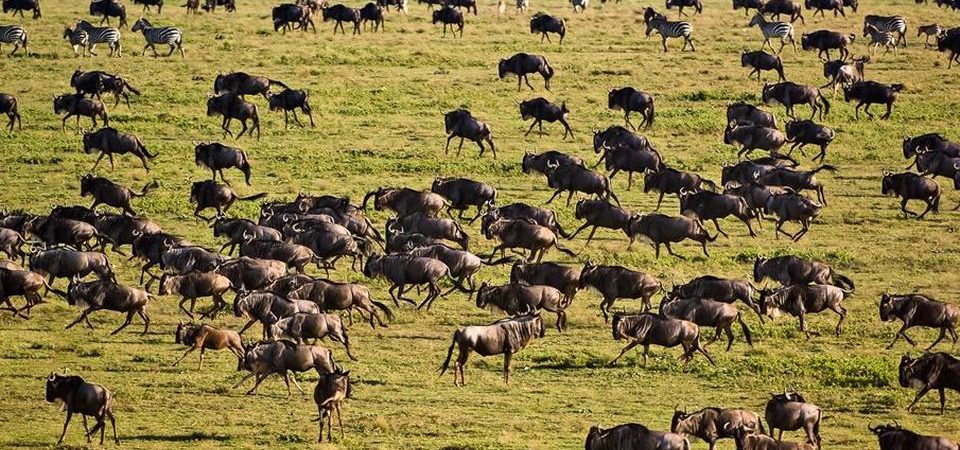
The annual Wildebeest Migration in Tanzania is one of the most spectacular wildlife events on earth, where millions of wildebeest, along with hundreds of thousands of zebras and gazelles, migrate across the Serengeti–Mara Ecosystem in search of fresh grazing lands and water. Over two million wildebeests and their entourage migrate through the Serengeti and Masai Mara Ecosystems in a predictable pattern. The Wildebeest Migration in Tanzania symbolizes a circle of life. This can not be seen anywhere else in the world, making it one of the most sought-after natural wonders.
In this article, we take you through an in-depth exploration of this captivating spectacle. From the awe-inspiring start, teeming with new life in the southern Serengeti to its dramatic conclusion. We will guide you through every facet of this remarkable event. Discover the intricate patterns of the Great wildebeest migration, to its diverse wildlife and natural thrills.
What Is The Great Wildebeest Migration?
The Great Wildebeest Migration is the largest terrestrial mammal migration on earth – a world natural wonder. Over two million wildebeest and their entourage (Zebras and Gazelles) move across the Serengeti and Masai Mara ecosystems. The migrating mammal grazers are guided by survival instincts. They cover about 800 to 1,000 km on individual journeys through the vast ecosystems of Tanzania and Kenya.
The Wildebeest Migration in Tanzania starts in the southern parts of Serengeti near Ngorongoro Conservation Area. Having birth of over half a million calves between January and March. These months of the year are associated with short rains in the southern Serengeti, making the grassy plains of the southern Serengeti lush green. The lush greenery that comes with this season is associated with the different nutritious grasses. Providing essential nourishment for the herds during the calving season. After the drastic spectacle of new life with thousands of new calves being born, adding to the excitement. The large mammal grazers then move northwards through the Serengeti National Park. Crossing to Masai Mara National Park in a clockwise direction before returning once again to the Serengeti near the end of the year.
The Wildebeest Journey Through Central Serengeti
As the grasses in the southern part of the Serengeti start to decrease. The herds move northwards through the central Serengeti. The herds encounter more varied terrain with woodlands and riverine forests. This adds to the diversity of this journey as the wildebeest and their entourage move, they attract hungry predators that roam the vast plains of the Serengeti and Masai Mara Ecosystem, including lions, leopards, hyenas, African Wild Dogs, cheetahs, and crocodiles that make sure only the strongest survive on this journey.
The herds spend several months in the central Serengeti grazing on the lush vegetation. While drinking from the abundant water sources from the seasonal rains. This region is associated with a large number of predators that come to prey on the valuable young calves. Wildebeest herds also engage in mating activities while in the central Serengeti in preparation for the next circle of life when they eventually return to the south.
As the grassy plains in the central Serengeti start to dwindle, the herds move northwards towards the Mara River. The herds start moving towards the northern Serengeti National Park, where they finally encounter the life-threatening Mara River.
The Mara River Crossing
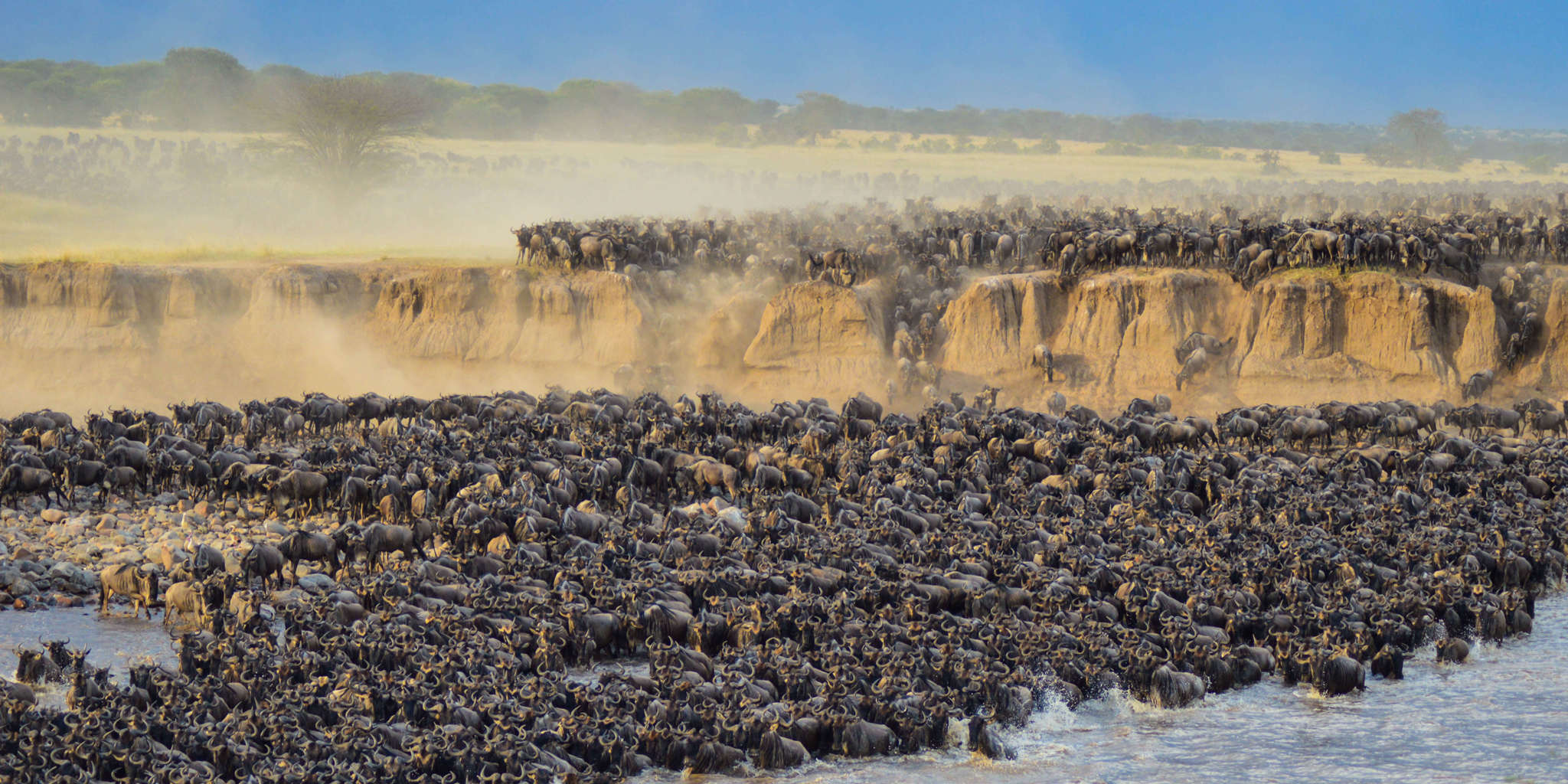
After gathering near the river banks for a few weeks. The time for the wildebeest to take on this life-challenging journey of crossing the crocodile-infested Mara River. About 3,000 crocodiles lie patiently waiting for a kill in the Mara River, making sure only the strongest survive. The Mara River crossing is the most spectacular during this Wildebeest Migration journey and is a major highlight of the Wildebeest Migration both in Tanzania and Kenya, not forgetting the other predators, especially lions that follow the migrating mammals, leaving them with no choice but to cross the crocodile-infested River. Witnessing a kill during the crossing is a common occurrence.
Masai Mara National Reserve – Wildebeest migration after arriving in Masai Mara
The strongest that make it past the crocodile-infested Mara River get the benefit of grazing. on the rich, nutrient-dense grasses, replenishing the energy used by the wildebeest during the arduous River crossing. The lush, nutrient-rich pastures and abundant water sources in the Masai Mara National Reserve will surely give the exhausted wildebeest a temporary respite from the harsher conditions experienced during their journey from the southern Serengeti plains.
Although the wildebeest might have made it alive to the Masai Mara National Reserve. They remain vigilant as the National Reserve also hosts a large number of predators, including cheetahs, lions, and hyenas that are likely to be waiting to prey on them.
Journey back to Serengeti – The wildebeest journey back to Serengeti National Park
As the dry season kicks in at Masai Mara National Reserve, the lush green turns into dry land, and the seasonal water sources dry up. This seasonal change prompts the wildebeest to start their journey back southwards to Tanzania’s Serengeti National Park. Guided by survival instincts, the wildebeest start retracing their path back through the Masai Mara Reserve, once more crossing the deadly Mara River.
The River crossing back to Serengeti National Park is equally challenging. The wildebeest encounters large numbers of obstacles, including the crocodiles that lie patiently in wait to make a kill. After the wildebeest crosses over to the Serengeti National Park, they follow the bearing to Lobo and Loliondo in the eastern Serengeti. They then continue with their journey to the southern Ndutu calving grounds, arriving in late December. They then repeat their cyclic journey after a temporary stay in the southern Serengeti up to March.
Where to see wildebeest each month of the year
When planning wildebeest migration Safari holidays to Kenya and Tanzania. The most frequently asked questions by most of our clients include: When is the great migration in Tanzania? What month is the Great Migration in Tanzania? When can you see the Wildebeest migration in Tanzania?
April to May
This period of the year is associated with rain in Tanzania. During these months, the herds of grazing mammals are still within the Southern plains of Serengeti. These months of the year are associated with heavy rains in this region of the park; however, a few accommodation facilities remain open, offering accommodation to visitors willing to venture into the Serengeti during this period of the year. Among the places where you can stay during these months are Serena or Sopa lodge. The early herds will have moved to the areas near the Grumeti River. Here, they gather for a few weeks before they proceed with their northward movement into the central Serengeti National Park.
August To October
In most cases during this period, the wildebeest are still in the northern Serengeti National Park. Most travelers assume that this time, the wildebeest are now in Kenya. which can logically sound well, but the reality is different. From July to October, there are more wildebeest herds within the northern Serengeti, and only a few herds have yet crossed to the Masai Mara National Reserve in Kenya.
These months also feature the spectacle Mara River crossing that sees wildebeest battle crossing the crocodile-infested Mara River. The river crossing in Tanzania is magnificent, with several crossing points allowing for multiple river crossing sightseeing opportunities. It all starts with one wildebeest taking a leap of faith, followed by the remaining wildebeest. By the end of October, most herds will have crossed to the neighboring Masai Mara National Reserve.
November
In late November, the wildebeest herds start their second migration southwards to the Serengeti National Park. They retrace their way back to Masai Mara National Park, and once more cross the crocodile-infested Mara River, an equally exciting spectacle to watch. They will crossover and proceed with their migration to the southern part of Serengeti National Park in the areas near the Ngorongoro Conservation Area.
December To March
The wildebeest start arriving in the southern Serengeti plains in December. in areas that extend to the nearby Ngorongoro Conservation Area. As they arrive in the areas around Lake Ndutu in the Ngorongoro Conservation Area, they spread across the vast savannas. All through December, January, February, and March, large herds of wildebeest graze in the southern plains of Serengeti National Park. During this time of the year, the southern part of the Serengeti is associated with lush grassy plains that are nutrient-rich and crucial for the nourishment of the calving wildebeests.
This season is also the wildebeest calving season. Here, over half a million wildebeest are born, replenishing life lost during the long round trek. The air in the southern plains is filled with new life as the young calves born. This adds to the excitement of this natural event. For those planning to visit a wildebeest safari this month of the year, the best place to see the wildebeest is the Southern Serengeti plains. Wildebeest Migration in Tanzania during these months of the year is popular among those interested in witnessing the spectacular calving of the wildebeest in Tanzania.


