
Akagera National Park
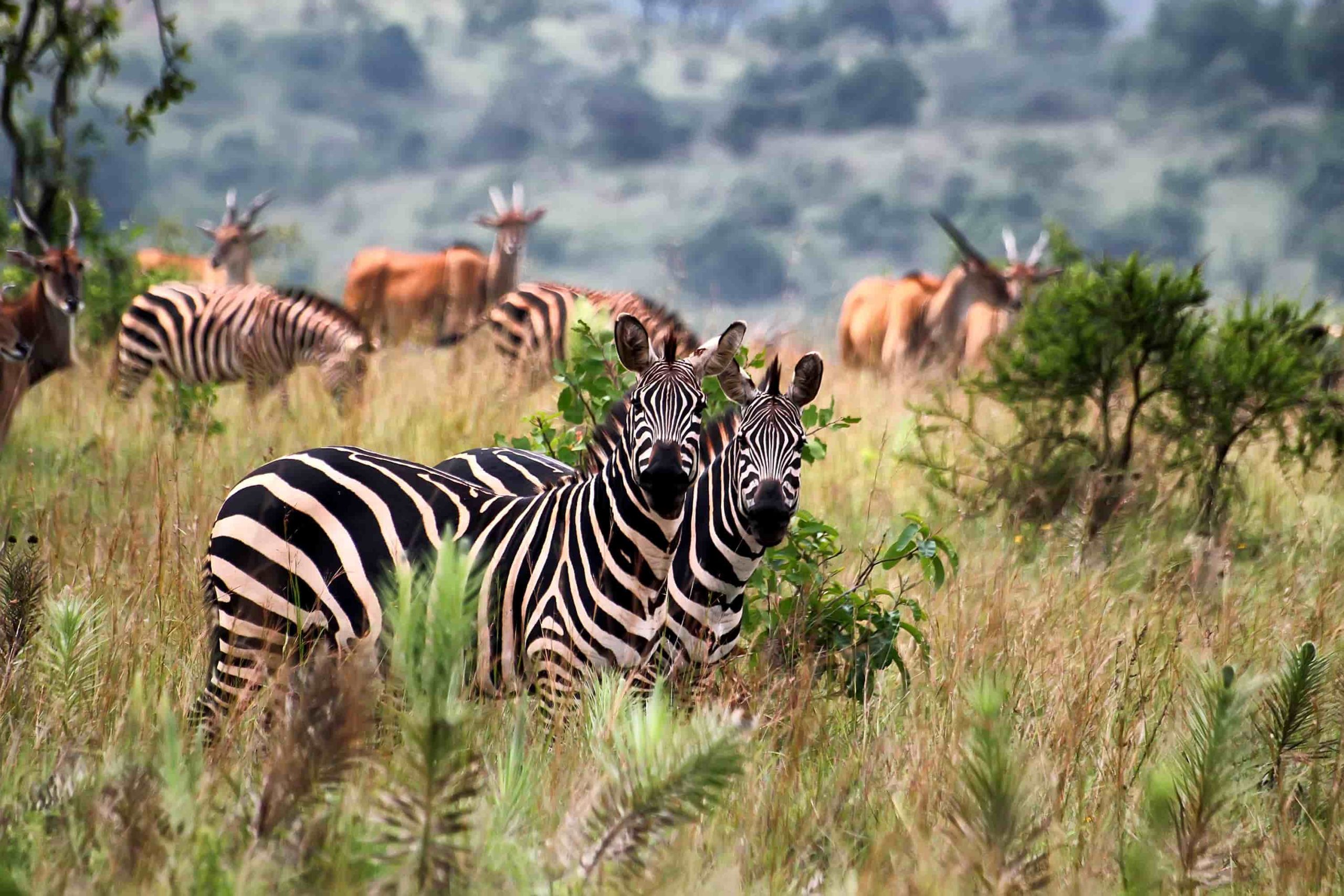
Akagera National Park in Rwanda comprises savannah, woodland, wetland, and a dozen lakes. It offers a beautiful view of the country’s wildlife and birds. The Big Five, i.e, leopards, lions, elephants, and Buffaloes, and other animal species like Zebras, impala, hippos, crocodiles, etc.
Akagera National Park was named after the River Kagera, also known as the Akagera River, which feeds several Lakes (Lake Gishanju, Lake Ihema, Lake Mihindi, Lake Rwanyakizinga, and Lake Shakani) within and around the park.
Wildlife In Akagera National Park
The park is Rwanda’s only savannah reserve and is again a Big Five destination after the recent reintroduction of lion and black rhino. Other animals include elephants, buffalo, giraffes, and hippos. In terms of pure wildlife viewing, Akagera can’t quite compete with the more famous parks in Kenya and Tanzania. However, the park is very scenic and the birdlife is particularly rewarding.
Wildlife numbers are on the increase in Akagera National Park, and animals are slowly becoming less skittish (problems have included human encroachment and poaching). Buffaloes are easily seen, and elephants are quite common, leopards are around but so secretive, lions were reintroduced from South Africa in 2015, and there were 19 in the park as of early 2018, along with the same number of black rhinos, which were reintroduced in 2017.
Scenery Of Akagera National Park
Akagera National Park is particularly scenic and offers a wide diversity of habitats in a small area. Visitors can drive along a string of forest-fringed lakes and wetlands fed by the Akagera River. Tall mountains form a lovely backdrop to the ever-changing vegetation, which includes papyrus swamps and acacia woodland.
Best Time To Visit Akagera National Park
Although Akagera National Park can be visited at any time, the best wildlife-viewing months are from June to September. This corresponds with the Dry season, when animals are drawn to the lakes as a source of water. At this time, the bush is not as lush either, which makes spotting animals a bit easier.
The Big Five in Akagera National Park
Akagera National Park officially became a Big Five park in May 2017. It now boosts thriving populations of lions, leopards, elephants, rhinos, and buffalo, as well as zebras, giraffes, and hundreds of bird species. Akagera National Park is the only national park in Rwanda with all the Big Five.
The most common throughout the park is the gracious impala, but the big herds of topi are of particular interest. Defassa waterbuck regularly graze around the lakes, and bushbuck is a widespread resident in the woodland areas. Additionally, the lakes support some of the highest concentrations of hippos and large crocodiles on the continent.
Lakes In Akagera National Park
There are 10 lakes located within Akagera National Park, which are explored by visitors in the park. some of the most commonly visited lakes include Lake Ihema and Lake Shakani.
Primates
Of the primate family, olive baboons and vervet monkeys are common in Akagera. Far rarer is the secretive blue monkey that, until a few years ago, was believed to be extinct in the park.
Herbivores
Elephant, rhino, giraffe, and hippopotamus are the largest mammals found in the park. They join several naturally occurring large plains game species, including buffalo, topi, zebra, defassa waterbuck, the elusive roan antelope, and the statuesque eland. Smaller herbivores include duiker, oribi, bohor reedbuck, klipspringer, bushbuck, and impala. The endangered Masai giraffe was introduced to Akagera from Kenya in 1986, and the current population contains an estimated 78 individuals.
Elephants have historically inhabited Akagera, but poaching had wiped them out until an initial reintroduction brought back a small group of 26 young elephants—each under eight years old—in 1975. The founder population has since increased to approximately 100 individuals.
2017 saw the historic return of 18 eastern black rhinoceros to Akagera—and Rwanda after a 10-year absence. The first calves were born in 2018, and the five black rhinos translocated from European zoos in June 2019 are expected to boost genetic diversity.
counter-poaching canine unit, African Parks overhauled law enforcement to help secure Akagera National Park, and, as a result, not one high-value species has been lost to poaching since 2010.
In 2017, 18 eastern black rhinoceros were reintroduced in Akagera, bringing the species back to the park and the country after a 10-year absence. The population was further supplemented by an additional five individuals translocated from European zoos in 2019.
Lions were reintroduced in 2015, and with the addition of two males in 2017 to increase genetic diversity, the population has since quadrupled.
More than 2,000 schoolchildren visit Akagera National Park each year, along with teachers and local leaders, as part of the environmental education programme.
By the close of 2019, Akagera was 90% self-financing, with revenue generated by almost 50,000 tourists, 50% of whom were Rwandan. Even though 2020 saw a 68% reduction in visitors due to COVID-19, Akagera continued to provide for the 300,000 people living on its boundary.
Top 5 Things to Do In Akagera National Park
Akagera National Park is nature’s blend of swamps, Lakes, savannah plains, and rugged terrain encircled by neatly terraced hills.
Established as a national park in 1934 and named after the river that flows through it, the River Kagera. It is situated northeast of the Rwanda border with Tanzania. The park features diverse vegetation zones and is home to numerous mammal and bird species, some of which can only be seen in Akagera National Park. There are many sights and sounds to enjoy while visiting the park, but here is a list of the top 5 things to do at Akagera National Park.
- Game Drives
On a game drive during the day, you get to be driven along the tracks, through the green savannah plains, past wide-leaved woodlands, and into the habitat of bountiful mammal species in the Akagera National Park. Your tour guide knows the areas where most animals usually spend their day and will endeavor to drive by Akagera National Park management offers nature walks in some areas of the park with a ranger guide. This is a good way to explore the park outside of a vehicle, which you use while on a game drive. Also, it allows more time and engagement concerning butterflies, insects, and plants that you could easily miss while on a safari.
- Fishing
You have an opportunity to fish while in Akagera National Park. You can do this on both Lake Ihema and Shakani, which is a thrilling experience. At the serene waters, you can fish to the background music of chirping birds and hippos that grunt as if to cheer you on. You are free to keep your catch to roast, fry or grill it and enjoy the taste of fresh fish from Rwanda.
- Birding in the park
Akagera National Park is home to over 480 species of birds, with many only found in this park in Rwanda. The diverse habitats for birds at Akagera National Park allow you to view different kinds of bird species. There will be birds in the savannah plains, in the hills, forests, by the lakes, and at the river. The Red-faced Barbets, the Great Snipe, the Lesser Kestrel, the Armot Chat, Swamp Fly Catchers, the Papyrus Gonolex, and the Shoebill are some of the most rewarding sights while birding.
- Boat Safari
A boat safari is a relaxing yet rewarding way to view wildlife. It is an even more rewarding experience when on the lake. Lake Ihema is the second largest lake in Rwanda, known for its abundant hippo population and crocodile-dotted shores. The boat safari on Lake Ilema offers the opportunity to take up-close photos of these animals. As other animals come to the lake for a drink or bath, you can take a look at those that you may have missed while out on a game drive in the wild.